
SUSTAIN will combine highly innovative research, user-centered design and rigorous standardised testing methods to explore novel, practical, scalable and sustainable solutions to materialise e-textiles. At every stage, sustainable materials and scalable processes will be evaluated, processes and designs for disassembly will be explored, and life cycle analyses (LCAs) will be used to inform decision-making and quantify environmental impact. Involving designers and engaging stakeholders will maximise system performance whilst ensuring e-textiles are acceptable and inclusive, catering for diverse users including gender, body shape, and user requirements.
Research Objectives
SUSTAIN has four overarching Research Objectives (RO):

RO1 Manufacturing and Sustainability
To realise circular and sustainable e-textile manufacturing techniques that ensure reliability over the garment lifetime, enable repair and re-use, textile circularity, and controlled degradation for zero-waste disposal (WP5), using low-energy processes familiar to the textile industry. Thus, creating responsible LCA-informed e-textile design and manufacturing frameworks utilising roll-to-roll compatible solution-processing.

RO2 Electronics and Connectivity
To heterogeneously integrate electronic devices and low-environmental impact semiconductors for wirelessly-enabled textiles with seamless communication (WP2), wireless power delivery (WP2, WP3), and non-invasive sensing (WP1). Thus, overcoming the inherent unreliability of interconnects through novel electromagnetics technologies.

RO3 Materials and Energy
To develop sustainable materials for textile electrochemical energy storage and multi-modal energy harvesting including wireless power (WP2) nanogenerators (WP3) and self-powered sensors (WP1). Thus, delivering safe, flexible, and robust textile power modules that remove the need for external batteries, utilising earth-abundant and non-toxic materials.

RO4 Design and E-Textiles Advocacy
To promote impactful low-TRL e-textile breakthroughs through garment-aware inclusive design (WP4) and stakeholders and industry-informed Demonstrators (WP6). Thus, e-textiles can serve as an advocacy platform for ICT-enabled solutions in healthcare, fashion, and industrial applications based on responsible technologies.
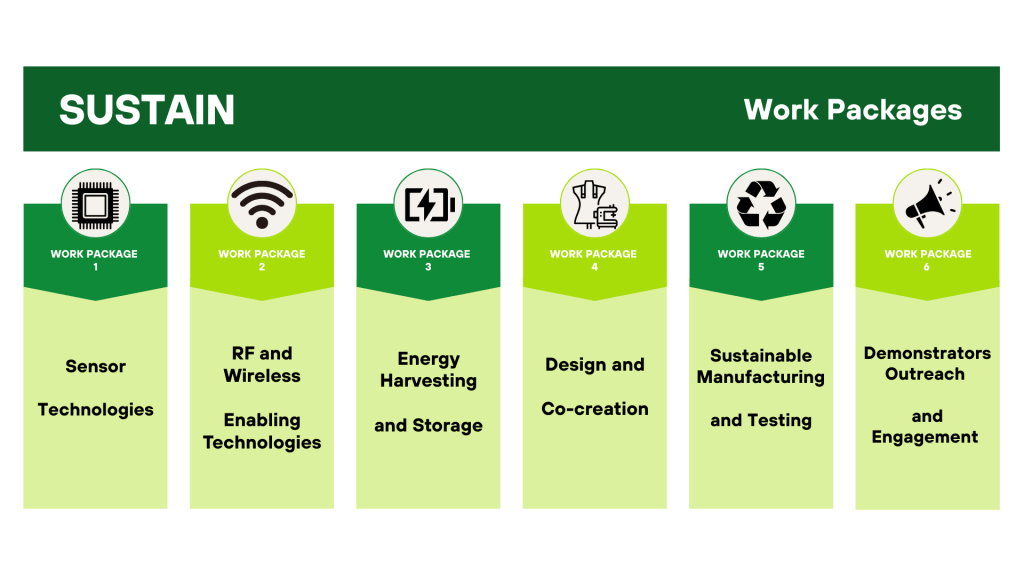
Work Packages
All of the overarching ROs will be achieved through six Work Packages (WP), each with their own Research Project Objectives. These Work Packages will be monitored through a set of key deliverables.
Meet the Work Package Leads and wider team.
 sustain-pg.org